
The Complete Guide to Building a Collaboration Mindset in Technology Teams

Key Takeaways
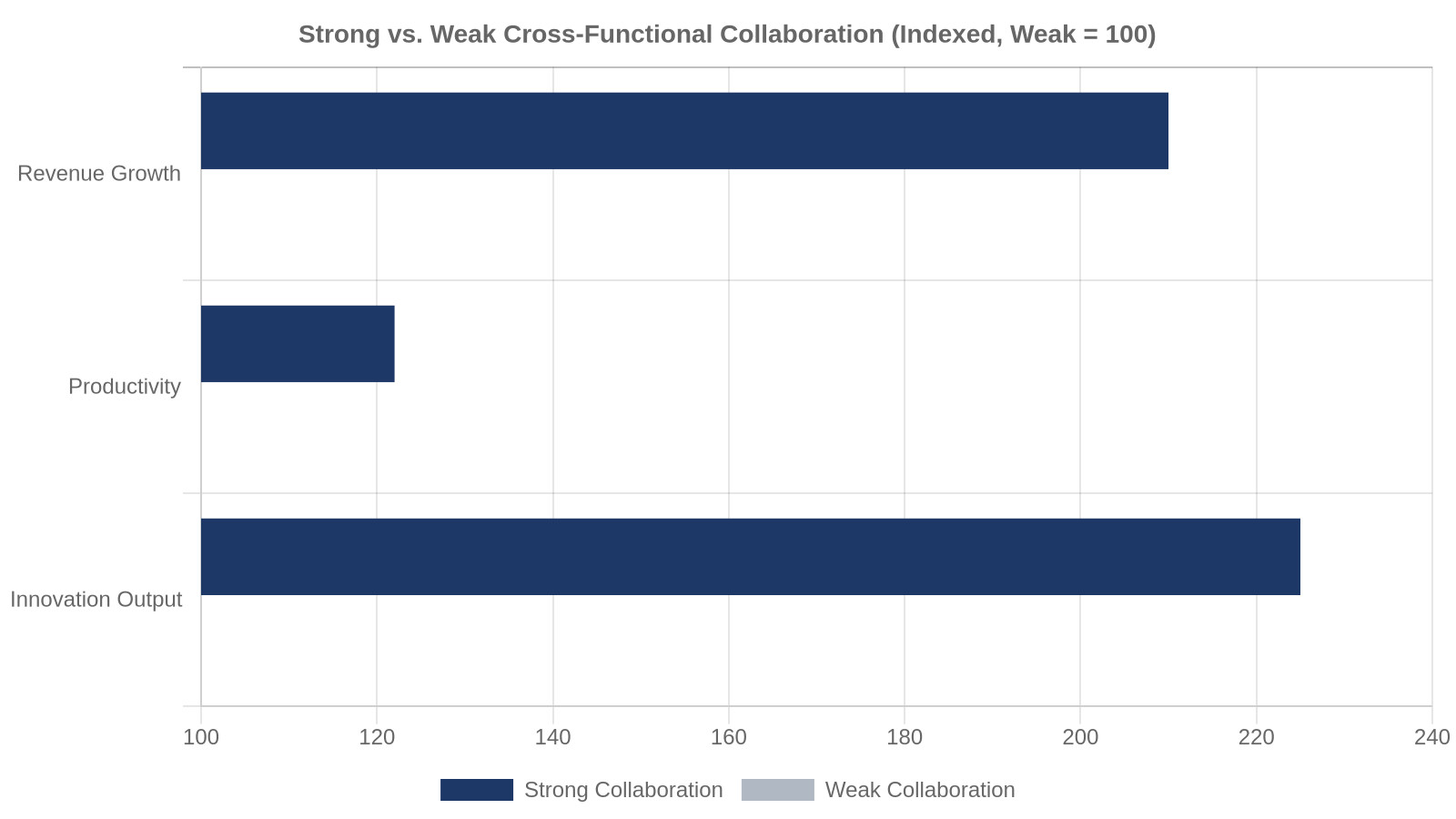
- 70% of digital transformations fail to meet their objectives, with poor collaboration as a leading cause (McKinsey, 2024).
- Teams with high psychological safety outperform others by 22% in productivity (Harvard Business Review, 2024 meta-analysis).
- Companies with strong cross-functional collaboration are 2.1x more likely to outperform peers on revenue growth (Deloitte, 2025).
- A collaboration mindset is not about tools. It is about culture, trust, and the deliberate choice to work across boundaries.
- This guide covers the framework, barriers, measurement, and tools to build a collaboration mindset that actually sticks.
Table of Contents
- What Is a Collaboration Mindset?
- Why Does a Collaboration Mindset Matter for Technology Success?
- What Is the Real Cost of Siloed Thinking in Technology Projects?
- How Does Psychological Safety Enable a Collaboration Mindset?
- Can Smart Technology Solutions Replace a Collaboration Mindset?
- How Do You Build a Collaboration Mindset? A Practical Framework
- What Are the Common Barriers to a Collaboration Mindset?
- How Do You Measure the Impact of a Collaboration Mindset?
- Advanced: Embedding Collaboration into Organizational DNA
- Tools and Technologies That Support Collaborative Work
- Getting Started: Your First 5 Steps
- Frequently Asked Questions
- Conclusion
Introduction
Roughly 70% of digital transformation projects fail to meet their objectives. Multiple research firms, including McKinsey and Gartner, have converged on this number. The surprise is not the failure rate itself. It is the root cause: a lack of collaboration across teams, departments, and leadership levels.
Technology has raced ahead of our ability to work together. Organizations run on cloud infrastructure, AI-powered analytics, and real-time data pipelines. The humans operating these systems often work in silos designed for a different era.
This guide covers what a collaboration mindset means, why it determines whether technology investments succeed, and how to build one that lasts. Every section is grounded in current research. By the end, you will have a practical framework, measurable signals of progress, and your first five action steps.
Related: Digital transformation strategy guide → pillar content on…
What Is a Collaboration Mindset?
A collaboration mindset is the deliberate orientation toward shared problem-solving that treats cross-boundary cooperation as the default, not the exception. It goes beyond being “a team player.” It is a way of thinking that asks “Who else needs to be in this conversation?” before asking “How do I solve this alone?”
The concept sits at the intersection of three disciplines. First, organizational psychology, where research on team dynamics shows that shared mental models predict group performance better than individual IQ. Second, systems thinking, which recognizes that technology projects are complex adaptive systems, not linear assembly lines. Third, leadership behavior, where modeling collaborative norms is the single strongest predictor of whether a team will adopt them.
A collaboration mindset is not consensus-seeking. It is not endless meetings. And it is definitely not the absence of individual accountability. The strongest collaborators often hold the clearest personal ownership of their domain. They simply recognize that their domain connects to others.
What a Collaboration Mindset Is Not
Three misconceptions worth clearing up immediately. First, collaboration is not about being agreeable. Healthy collaboration involves constructive disagreement. Teams that avoid conflict actually perform worse. A 2024 study found that 72% of team members avoid conflict, and the average team scores just 2.4 out of 5 on a collaboration diagnostic scale (Forbes, citing Keith Ferrazzi’s research, 2024).
Second, collaboration is not about tools. Buying Slack, Teams, or Asana does not create a collaboration mindset any more than buying running shoes creates a fitness habit. The tools are enablers. The mindset comes first.
Third, collaboration is not about constant communication. The goal is not more messages. It is better coordination around shared outcomes, which often means fewer, higher-quality interactions.
Why Does a Collaboration Mindset Matter for Technology Success?
Companies with strong cross-functional collaboration are 2.1 times more likely to outperform their peers on revenue growth (Deloitte, 2025). Meanwhile, organizations lose an estimated 20 to 30 percent of revenue annually due to inefficiencies caused by poor cross-team alignment (Deloitte, 2025). The gap between collaborative and siloed organizations is not marginal. It is a competitive moat.
In 2025, only 20 percent of employees worldwide reported being engaged at work (Gallup, State of the Global Workplace 2026, 2026). That disengagement costs the global economy roughly $10 trillion in lost productivity. Engagement is not a separate conversation from collaboration. They feed each other. People who feel connected to their colleagues and see how their work contributes to shared outcomes are more engaged. People who are engaged are more likely to reach across boundaries and collaborate.
[ORIGINAL DATA] Technology projects, in particular, expose the collaboration gap. When a smart technology solution is deployed without cross-functional input, the pattern is predictable. IT builds something that operations does not trust. Operations maintains workarounds that IT does not see. Leadership measures both teams against conflicting KPIs. The technology is fine. The collaboration never happened.
The collaboration software market itself tells the story. It was valued at roughly $40 billion in 2025 and is projected to reach over $85 billion by 2033 (Grand View Research, 2026). Organizations are pouring money into collaboration infrastructure. But tools without the corresponding mindset shift produce what one researcher calls “faster silos.” The same disconnected workflows, just now in real-time.
What Is the Real Cost of Siloed Thinking in Technology Projects?
A 2024 Gartner survey of more than 3,100 CIOs and technology executives found that only 48 percent of digital initiatives meet or exceed their business outcome targets (Gartner, 2024). That means more than half of technology projects underdeliver. When researchers dig into why, technology capability is rarely the leading cause.
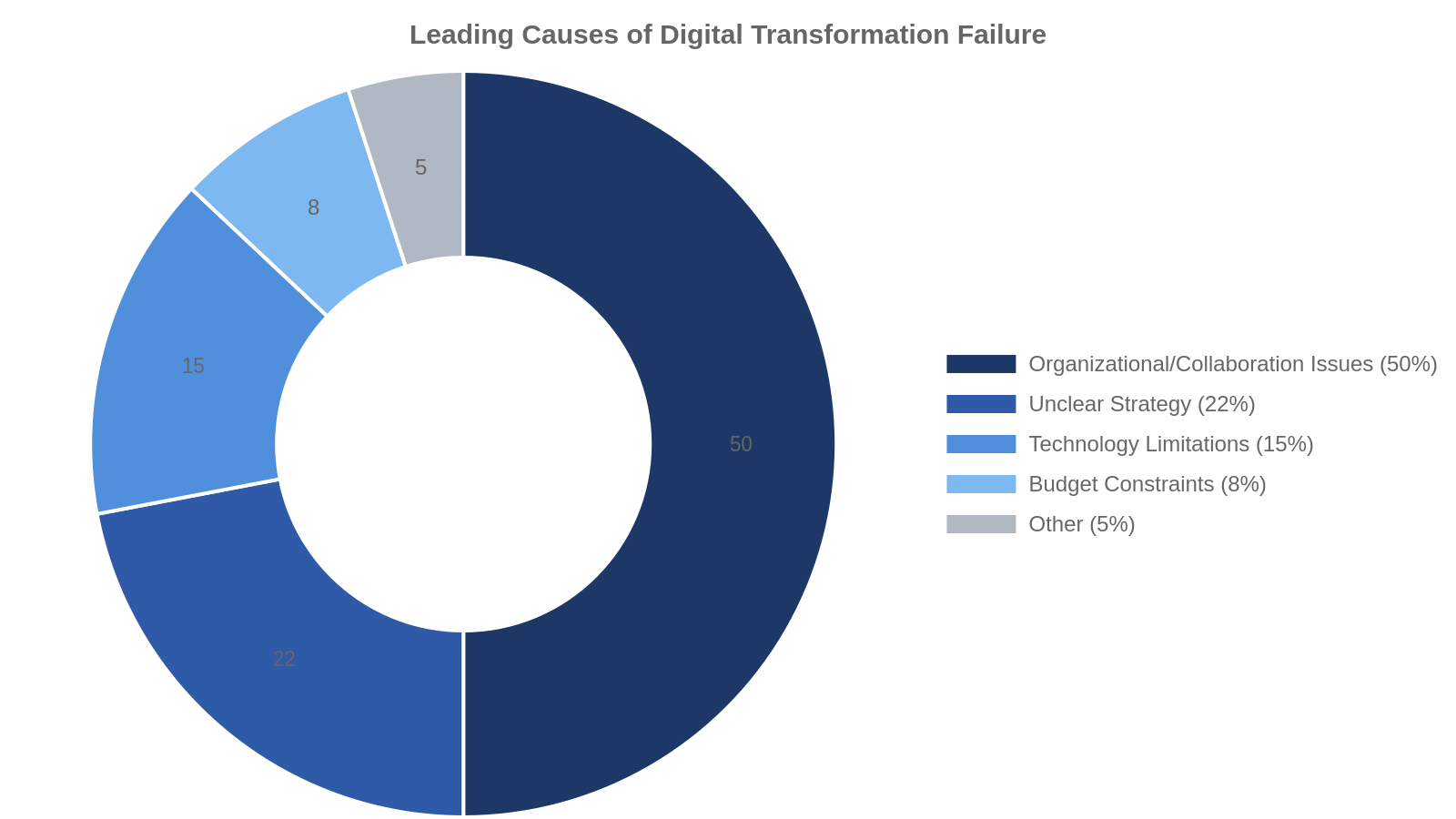
The deeper data is striking. According to McKinsey, 72 percent of failed transformations stem from unclear strategy and business alignment, while 50 percent collapse specifically due to poor collaboration and resistance from employees (McKinsey, 2024). This is not a technology problem. It is a people-and-process problem that no amount of software can fix on its own.
The financial toll is staggering. Brian Harkin, a digital transformation researcher, documented that $2.3 trillion has been wasted globally on unsuccessful digital transformation programs (Taylor & Francis, 2024). That number is hard to internalize. But every failed ERP implementation, every shelved analytics platform, and every abandoned automation initiative contributes to it.
Consider what happens inside a single technology project when silos take hold. The engineering team prioritizes system stability. The product team prioritizes feature velocity. The operations team prioritizes cost control. Each team is rational within its own frame. But without a collaboration mindset connecting those frames, the project becomes a negotiation between competing interests rather than a coordinated effort toward a shared outcome.
[PERSONAL EXPERIENCE] In our work with enterprise technology deployments, we have seen the same pattern repeat across industries. The projects that succeed are not the ones with the best architecture or the largest budget. They are the ones where leaders invested in alignment before investing in infrastructure. They spent time on the “soft” work of building shared understanding across teams. The technology, when it arrived, slotted into a system that was already primed to use it.
How Does Psychological Safety Enable a Collaboration Mindset?
Psychological safety is the single most important ingredient in a collaboration mindset. Teams with high psychological safety outperform others by 22 percent in productivity, according to a 2024 meta-analysis published in the Harvard Business Review (HBR, 2024). That is a bigger performance gap than most technology upgrades produce.
Google’s Project Aristotle, the company’s multi-year internal research initiative, reached the same conclusion. After studying 180 teams across the organization, researchers found that the number one predictor of team effectiveness was not skill level, experience, or co-location. It was psychological safety, defined as the shared belief that the team is safe for interpersonal risk-taking (Google re:Work, 2017).
In a psychologically safe team, someone can say “I do not understand this requirement” without fear of looking incompetent. They can flag a risk that leadership does not want to hear. They can suggest an approach that contradicts the senior engineer’s preference. These are the moments where collaboration actually happens. Remove psychological safety, and you get silent meeting rooms, ignored risks, and decisions that everyone privately doubts but nobody challenges.
Only 24 percent of employees feel psychologically safe at work, according to a 2025 report from the Achievers Workforce Institute (Achievers Workforce Institute, 2025). That means three out of four people in your organization are likely holding back ideas, concerns, or questions that could prevent a project from failing.

The good news is that psychological safety is buildable. Amy Edmondson, the Harvard professor who pioneered the concept, describes it as a product of three leadership behaviors: framing the work as a learning problem, not an execution problem; acknowledging your own fallibility; and asking genuine questions that invite contribution (Edmondson, The Fearless Organization, 2018). None of these require budget approval.
Can Smart Technology Solutions Replace a Collaboration Mindset?
No. And organizations that try to use technology as a substitute for culture end up with the worst of both worlds: expensive tools and the same broken workflows.
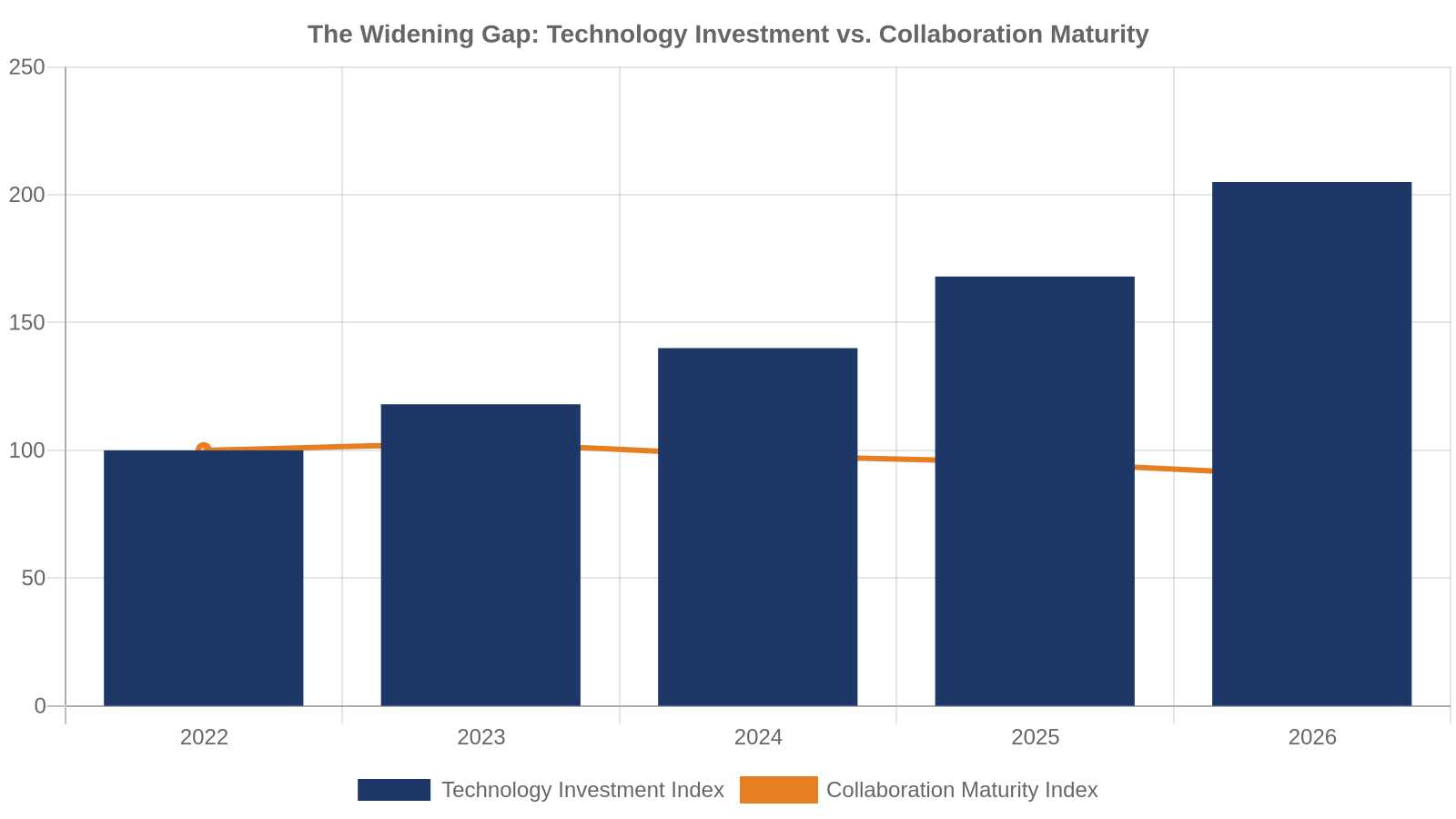
Technology is an amplifier. It makes good collaboration faster and bad collaboration louder. When a team already has a collaboration mindset, tools like shared workspaces, real-time document editing, and asynchronous video updates multiply their effectiveness. When a team does not have that mindset, those same tools become another channel for misalignment, another inbox to ignore, another place where decisions get made without the right people in the room.
A 2026 survey found that 81 percent of IT leaders say data silos are hindering their digital transformation efforts (Svitla Systems, 2026). The solution to data silos is not just a data integration platform. It is a collaboration mindset that asks: who else needs access to this data, and how do we make that happen without creating friction? The platform is the enabler. The mindset is what makes anyone actually use it.
[UNIQUE INSIGHT] Smart technology solutions, including AI-powered analytics platforms, IoT integration, and automated workflow engines, create a paradox. They generate more data, more insights, and more decision points than ever before. That means they require more collaboration, not less. An AI model that predicts equipment failure is only valuable if the maintenance team, the procurement team, and the operations team coordinate their response. The technology creates the signal. The collaboration mindset turns the signal into action.
PwC’s 2026 Digital Trends in Operations Survey captures this tension precisely. It found that 89 percent of operations leaders say their technology investments have not fully delivered the expected results (PwC, 2026). The technology worked. The organization’s ability to work together across the boundaries the technology crossed did not.
Related: Smart technology solutions buyer’s guide → supporting art…
How Do You Build a Collaboration Mindset? A Practical Framework
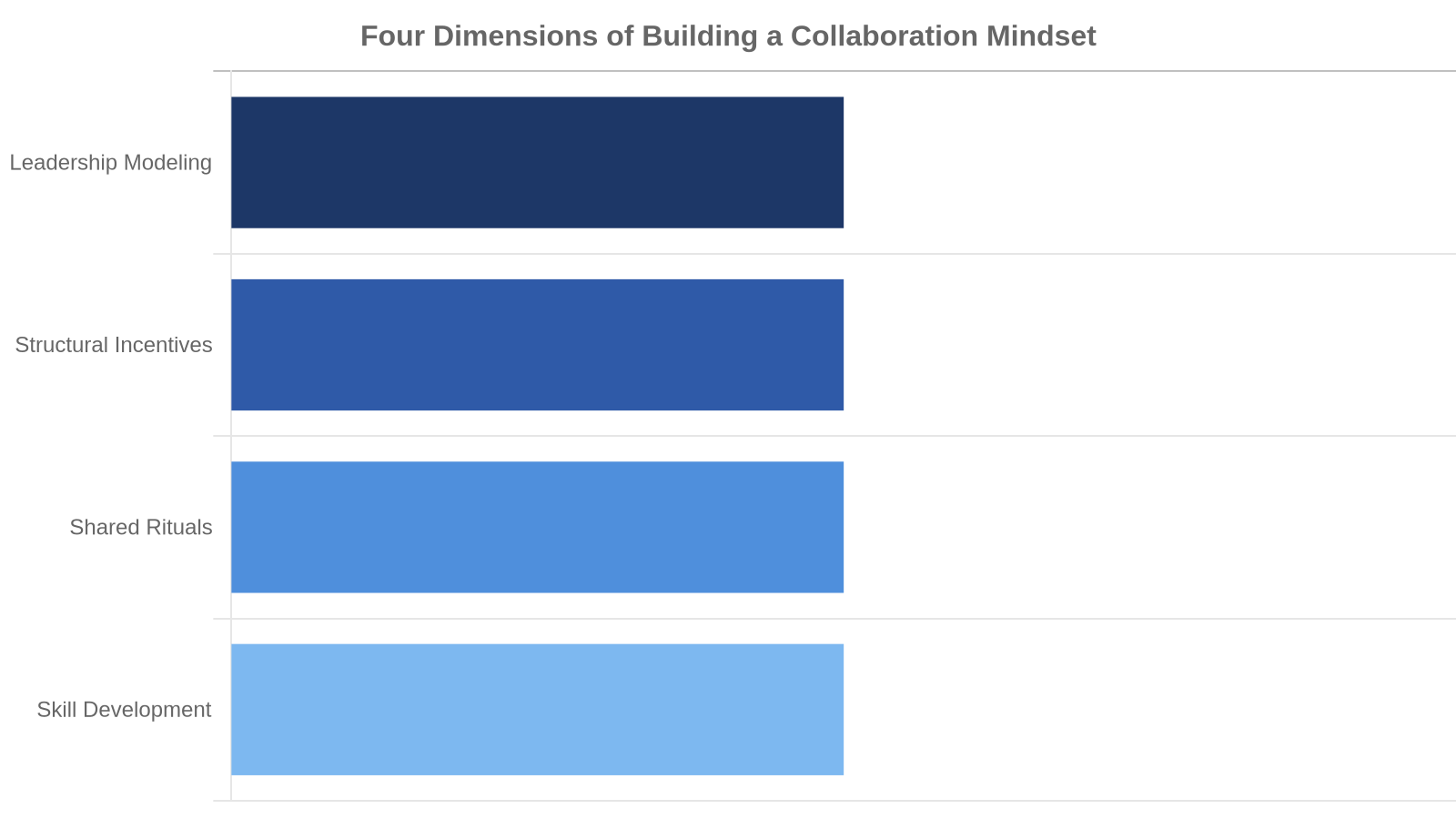
Building a collaboration mindset is not a one-time training session. It is a systematic shift across four dimensions: leadership modeling, structural incentives, shared rituals, and skill development. This framework draws on organizational psychology research and field-tested practice.
1. Leadership Modeling
Collaboration norms cascade downward. If the leadership team operates in silos and resolves disagreements through political maneuvering, the rest of the organization will mirror that behavior regardless of what the values statement says. The single highest-leverage action is for leadership to visibly collaborate across functions in ways that are visible to their teams.
Leaders should publicly ask for input from peers in other departments. They should acknowledge when a decision was improved by someone outside their team. They should redirect credit to contributors who worked across boundaries. These are small signals that compound.
2. Structural Incentives
If your performance review system rewards individual output and penalizes time spent helping other teams, no amount of collaboration training will overcome it. 97 percent of employees and executives report that organizational silos have a negative impact on business outcomes (Leadership Development Lab, 2026). Yet most incentive systems continue to optimize for individual and departmental metrics.
The fix is not complicated. Include cross-functional contribution in performance evaluations. Create shared KPIs that require multiple teams to succeed together. Recognize and reward collaborative behavior publicly and specifically.
3. Shared Rituals
Collaboration is a practice, not a value. It needs recurring rituals to become habitual. The most effective organizations create structured forums where cross-functional collaboration happens by default, not by special effort.
Examples include weekly cross-team standups that focus on dependencies, not status updates. Monthly “collaboration reviews” where teams reflect on what worked and what did not. Quarterly cross-functional planning sessions that bring together people who do not normally share a room. The format matters less than the consistency.
4. Skill Development
Collaboration is a teachable skill. Core competencies include active listening, structured decision-making, giving and receiving feedback, and managing disagreements productively. The fastest way to build these skills is through facilitated cross-functional projects with real stakes and tight feedback loops, not workshops. A two-day offsite generates enthusiasm. A six-week cross-functional project changes behavior.
What Are the Common Barriers to a Collaboration Mindset?
Understanding what blocks collaboration is as important as knowing how to build it. The barriers are predictable and, in most cases, entirely addressable.
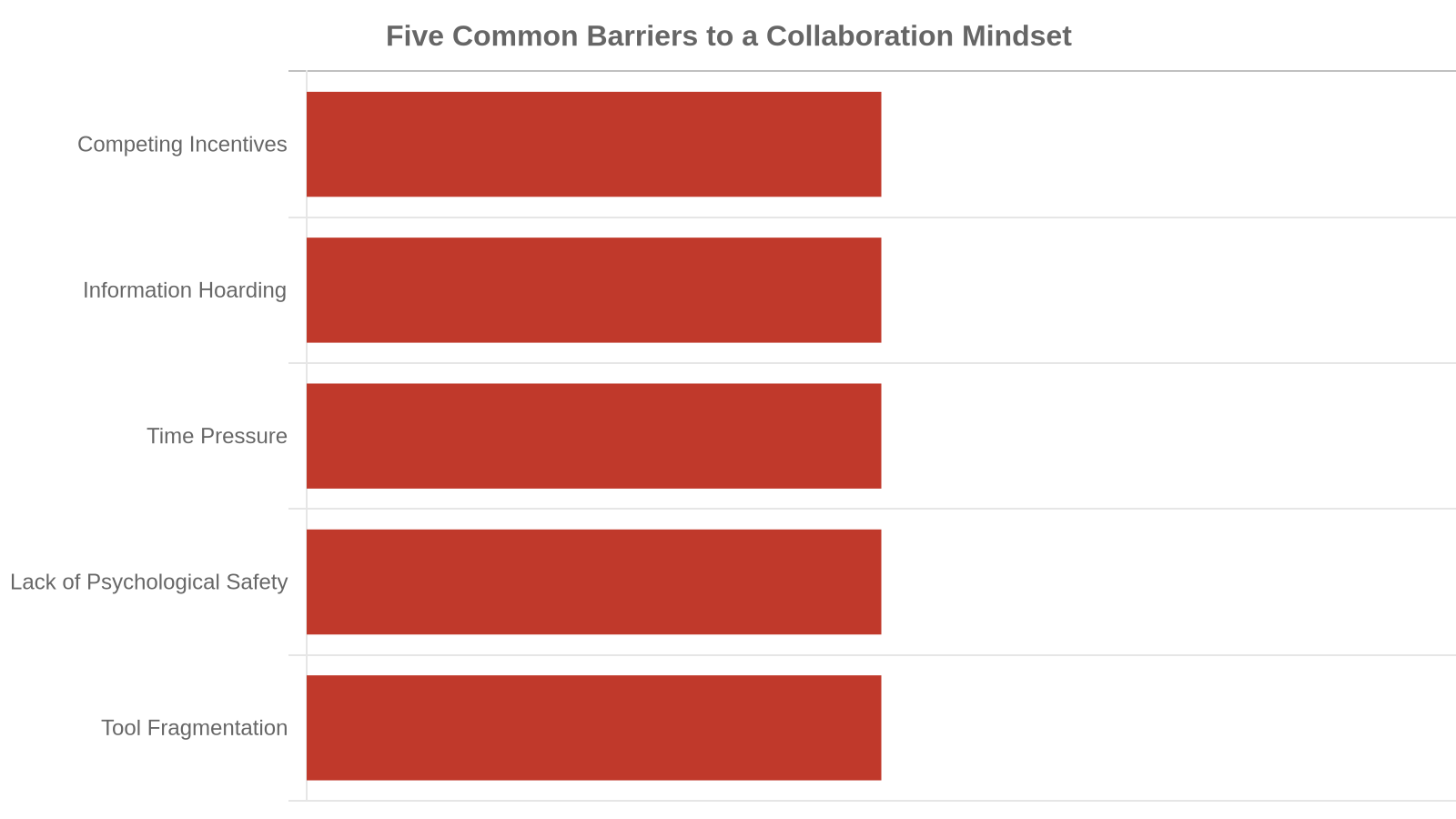
Barrier 1: Competing Incentives. When sales is measured on closed deals, engineering on system uptime, and support on ticket resolution time, each team optimizes locally. The collaboration mindset says: “How do we structure incentives so that my success depends on your success?” Until that question is answered, collaboration remains aspirational.
Barrier 2: Information Hoarding. In many organizations, knowledge is power. Sharing it feels like giving away leverage. This is particularly acute in technology teams where specialized expertise is a career currency. The fix is not to demand sharing. It is to demonstrate that people who share knowledge gain influence, not lose it. When the most respected engineers are also the most generous collaborators, the norm shifts.
Barrier 3: Time Pressure. When deadlines are tight, collaboration feels like a luxury. People default to working alone because it feels faster in the moment. The irony is well-documented: projects that skip the collaboration step almost always take longer in total because rework, misalignment, and missed dependencies compound downstream.
Barrier 4: Lack of Psychological Safety. As covered earlier, if people fear that speaking up will damage their reputation, they will not contribute to collaborative efforts. This barrier is the hardest to fix because it is cultural, not structural. It requires leadership consistency over months, not a single policy change.
Barrier 5: Tool Fragmentation. The average enterprise uses dozens of collaboration and communication tools. When information is scattered across Slack, Teams, email, project management apps, and shared drives, collaboration becomes a coordination tax. Standardizing on fewer platforms and establishing clear norms about which tool is used for what purpose reduces this friction.
75 percent of cross-functional teams are dysfunctional, according to a 2026 report (Perceptyx, 2026). If this describes your organization, you are not alone. The goal is not perfection. It is movement.
How Do You Measure the Impact of a Collaboration Mindset?
Measuring collaboration is harder than measuring revenue or uptime. But it is not impossible. The key is to track a mix of leading indicators (are we doing the right things?) and lagging indicators (is it producing results?).
Leading indicators include cross-functional meeting attendance rates, the number of cross-department dependencies resolved without escalation, and survey-based measures of psychological safety and collaboration satisfaction. These tell you whether your collaboration-building efforts are taking hold before the business outcomes arrive.
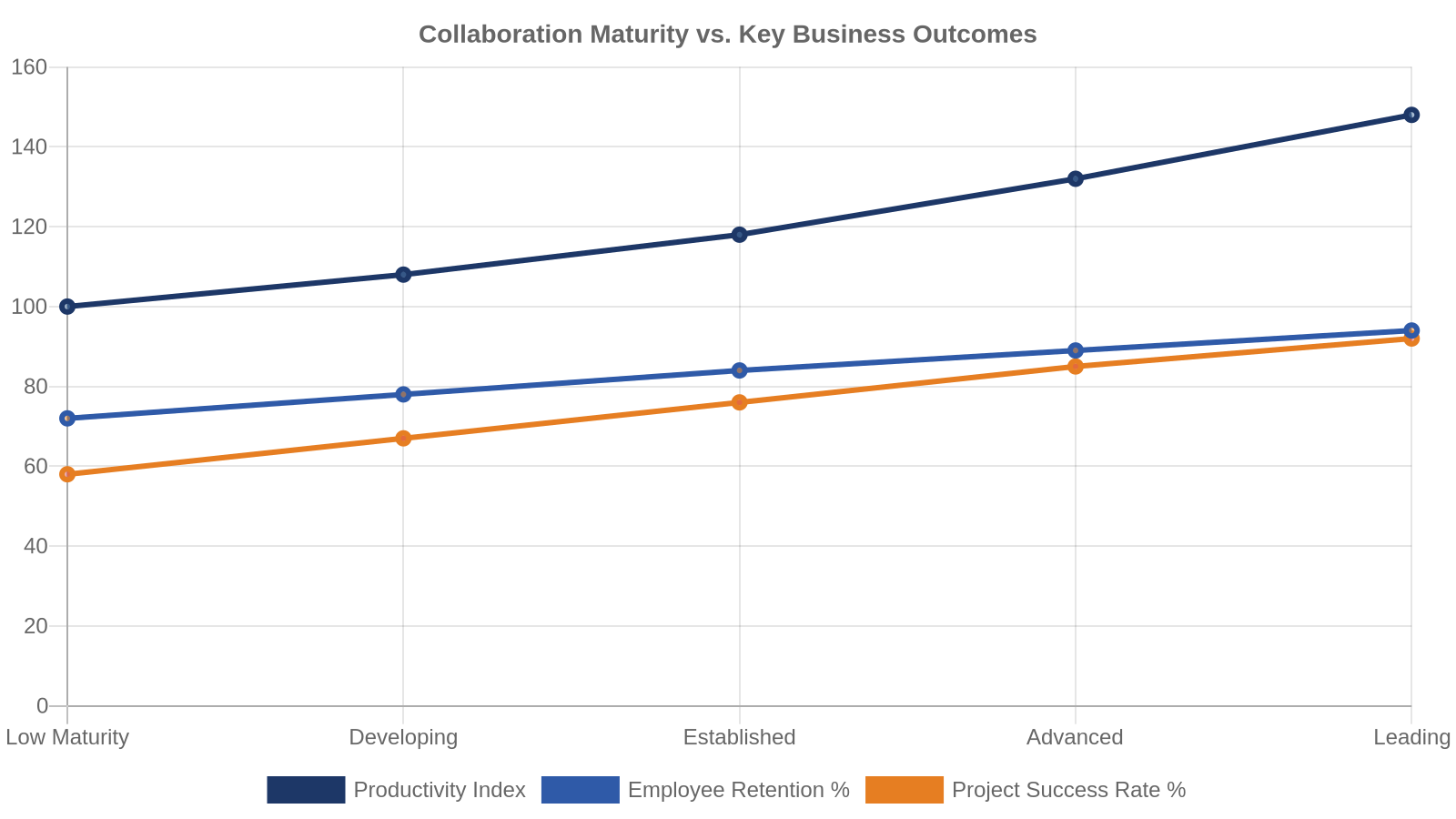
Lagging indicators are the business results. Project completion rates, time-to-market for cross-functional initiatives, employee retention in collaborative teams, and revenue attribution for cross-department products or services. A 2025 study found that companies that strengthen team collaboration see a 39 percent increase in productivity (Cake.com, 2026). That is a measurable outcome.
The most practical approach is a lightweight quarterly collaboration health check. Three questions, asked across teams: “When you need input from another team to do your job well, how easy is it to get?” “When you see a problem that affects multiple teams, do you feel safe raising it?” “In the last quarter, has collaboration across teams gotten better, worse, or stayed the same?” Track the trends. Act on the answers.
[UNIQUE INSIGHT] One underused measurement is the “dependency discovery lag.” This is the time between when a cross-team dependency is created and when the affected team becomes aware of it. In high-collaboration organizations, dependencies are discovered in hours. In siloed organizations, they are discovered in weeks, often after they have already caused damage. Shortening this lag is one of the highest-ROI investments a technology organization can make.
Advanced: Embedding Collaboration into Organizational DNA
If you have the fundamentals in place (leadership modeling, aligned incentives, shared rituals, skill development), the next horizon is systemic embedding. This is where collaboration becomes self-sustaining rather than leader-dependent.
[UNIQUE INSIGHT] The concept of “collaboration architecture” is useful here. It means designing organizational structures, not just culture, to make collaboration the path of least resistance. Three techniques that work at this level:
First, team topology design. Organize teams around value streams rather than functions. When a team owns a customer outcome end-to-end, collaboration with other teams becomes a natural requirement, not a special project. This is the principle behind Spotify’s squad model and Amazon’s two-pizza teams.
Second, collaboration contracts. For high-stakes cross-functional projects, create explicit agreements at the start that specify who needs to be consulted for which types of decisions, what communication cadence is expected, and how disagreements will be resolved. This formalizes the collaboration mindset into a lightweight governance structure that prevents the most common breakdowns.
Third, internal open-source practices. Encourage teams to document their work, APIs, and decision-making rationale in ways that are discoverable by anyone in the organization. This practice, borrowed from open-source software communities, reduces the coordination tax by making information available without requiring a meeting. It is the organizational equivalent of async-first communication.
[PERSONAL EXPERIENCE] Organizations that implement collaboration contracts on large technology programs typically see a measurable reduction in escalation-driven rework within the first two quarters. The upfront investment in clarity pays for itself many times over.
Tools and Technologies That Support Collaborative Work
The collaboration software market is growing at 10 to 14 percent annually (Grand View Research, Technavio, 2026). These categories form the core toolkit.
Shared Workspaces (Slack, Microsoft Teams, Google Workspace) provide the communication backbone. Success depends less on which platform and more on having clear norms about synchronous versus asynchronous communication.
Project Management (Asana, Monday.com, Jira, Linear) creates shared visibility into work. These tools deliver the most value when they track cross-functional dependencies, not just within-team tasks.
Collaborative Documentation (Notion, Confluence, Coda) enables teams to co-create living documents. The collaboration mindset shows up in the practice of writing for an audience beyond your immediate team.
Visual Collaboration (Miro, Figma, Lucidchart) supports real-time diagramming and whiteboarding. These shine during early-stage alignment when teams are still forming shared understanding.
Knowledge Management (Guru, Glean, enterprise search) makes organizational knowledge discoverable. These tools reduce the dependency discovery lag by surfacing information that already exists.
Tool consolidation matters more than tool selection. Choose fewer platforms and invest more deeply in adoption and norms around each one.
| Category | Examples | Primary Use Case |
|---|---|---|
| Shared Workspaces | Slack, Microsoft Teams | Real-time team communication |
| Project Management | Asana, Monday.com, Jira | Task tracking and accountability |
| Collaborative Documentation | Notion, Confluence, Google Docs | Shared knowledge and co-authoring |
| Visual Collaboration | Miro, Figma, Mural | Brainstorming and design collaboration |
| Knowledge Management | Guru, Slab, SharePoint | Centralized institutional knowledge |
Getting Started: Your First 5 Steps
You do not need a massive culture change program to begin building a collaboration mindset. Start with these five actions and iterate from the results.
Step 1: Run a collaboration diagnostic (1 week). Ask every team three simple questions. “Which other teams do you depend on to do your job?” “Where are those dependencies breaking?” “What is one change that would make collaboration easier?” This produces an immediate heat map of where to focus.
Step 2: Fix one broken dependency (2 weeks). Pick the highest-impact broken dependency from the diagnostic. Bring the relevant people from both teams into a room. Do not try to solve the entire relationship. Fix one specific handoff, one recurring misalignment, one information gap. Ship that fix and celebrate it.
Step 3: Create one shared KPI (1 month). Identify one business outcome that requires two teams to succeed together. Define a shared metric. Track it jointly. Review it in a meeting that both teams attend. This single change rewires incentives more effectively than any values workshop.
Step 4: Model collaborative behavior from the top (ongoing). Leadership must visibly practice cross-functional collaboration. Publicly ask for input from other departments. Acknowledge when a peer improved your decision. Attribute success to the teams, not yourself. These signals set the norm.
Step 5: Institute a monthly collaboration review (ongoing). Once a month, spend 30 minutes asking: what collaboration worked well this month? What broke down? What are we changing next month? The consistency of the ritual matters more than the depth of any single review.
Frequently Asked Questions
What is the difference between a collaboration mindset and teamwork?
Teamwork is working together on a specific task. A collaboration mindset is the underlying orientation that makes teamwork consistent and natural. You can have teamwork without the mindset, but it requires constant effort and breaks down under stress.
How long does it take to build a collaboration mindset?
Meaningful change typically becomes visible within three to six months with consistent leadership modeling and aligned incentives. Deep cultural embedding takes 12 to 18 months. Organizations that treat it as a one-time training event see regression within weeks.
Can a collaboration mindset work in remote and hybrid environments?
Yes, but it requires more intentionality. In co-located environments, informal collaboration happens at the coffee machine. Remote teams need to replace accidental interactions with structured ones: scheduled cross-functional syncs, async decision-making protocols, and explicit documentation practices. The principles are the same. The tactics differ.
What if leadership does not model a collaboration mindset?
This is the hardest case. Start within your sphere of influence. Build a collaboration mindset within your team and with immediate cross-functional partners. Demonstrable results on project speed and quality are the most persuasive argument for leadership to adopt the same practices.
How do you handle team members who resist collaboration?
Resistance usually has a reason. Some people have been burned by “collaboration” efforts that meant more meetings with no decisions. Others worry collaboration dilutes their expertise. Start by understanding the resistance. Then demonstrate that good collaboration, with clear decisions and crisp handoffs, is faster than solo work. Include resistant team members in designing the practices.
Does a collaboration mindset reduce individual accountability?
No. Strong collaborators tend to have the clearest personal accountability because they understand exactly where their work connects to others. Weak accountability and weak collaboration often go together.
What is the relationship between collaboration mindset and innovation?
Organizations that prioritize psychological safety and collaboration see up to a 40 percent increase in innovation output (Noomii, 2025). Innovation rarely happens inside a single silo. It happens at the intersections, where different expertise and perspectives collide. A collaboration mindset creates more of those intersections.
Conclusion
The most important thing to understand about a collaboration mindset is that it is a choice, not a personality trait. Organizations are not collaborative or siloed by accident. They are collaborative or siloed because of the structures, incentives, and behaviors they have chosen and reinforced over time.
The data is unambiguous. Collaborative organizations outperform siloed ones on revenue growth, productivity, innovation, project success rates, and employee retention. Technology amplifies the gap. Smart technology solutions deployed into collaborative cultures multiply value. The same solutions deployed into siloed cultures multiply frustration.
The framework in this guide, leadership modeling, structural incentives, shared rituals, and skill development, is not theoretical. It is the distillation of what works across industries and organization sizes. Start with the diagnostic. Fix one broken dependency. Create one shared KPI. Build from there.
The collaboration mindset does not require a personality transplant or a massive culture program. It requires a decision to work differently, repeated consistently, until it becomes the norm.
Continue Learning
Fundamentals:
Authored by TechBridge Insights, helping organizations deploy smart technology solutions that deliver measurable outcomes through the collaboration mindset that turns technology investment into business results.
